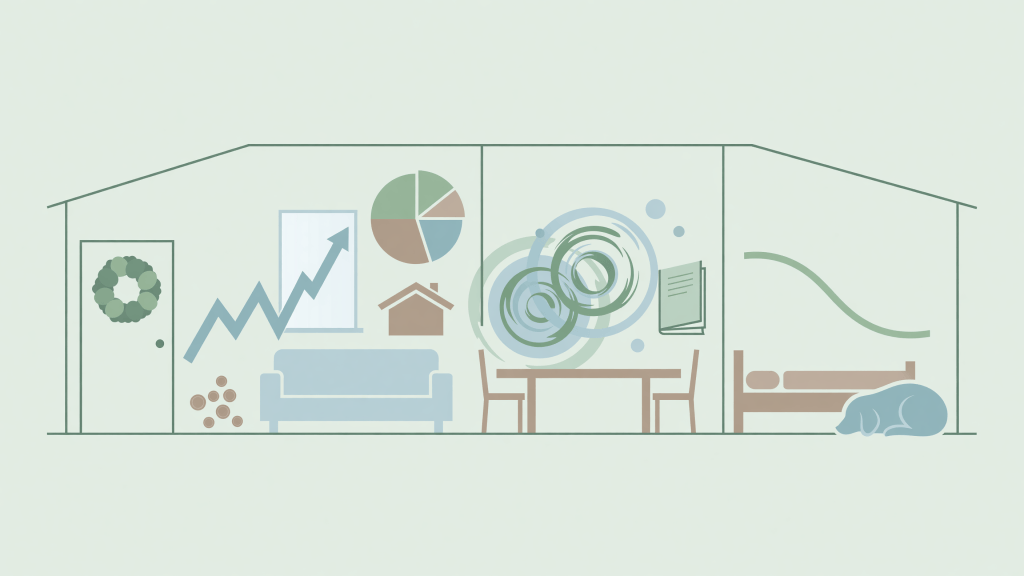
The holidays are supposed to feel like a Hallmark movie. Candles, casseroles, cousins you only tolerate because of the food. But if you have a reactive dog, surviving the holidays with a reactive dog can feel more like a live-action stress test you didn’t sign up for.
The doorbell rings fourteen times. Uncle Dave’s kids run through the house shrieking. Someone brings their own dog — announced approximately thirty seconds before arrival. And through all of it, your big feelings dog is doing what big feelings dogs do: reacting, loudly, with their whole body.
You are not failing. Your dog is not broken. You just need a plan that was actually designed for your life, not a theoretical golden retriever who greets strangers like a campaign volunteer.
Here’s the room-by-room guide you actually need.
Before Anyone Arrives: Setting the Stage for Managing a Reactive Dog During Holiday Gatherings
The work happens before the first car pulls into the driveway. Reactive dog management is almost entirely proactive, not reactive — the irony is not lost on any of us.
Have the conversation early. Text your guests before the day. Something like: “Hey, we love having you. Quick heads-up — our dog is working on some big feelings around new people. We’ll have her settled in her space when you arrive. Please don’t try to greet her, and if she barks, just ignore her. It genuinely helps.” That’s it. You don’t owe anyone a dissertation on the difference between reactive and aggressive. A one-paragraph heads-up handles most situations.
Walk before the chaos hits. A solid decompression walk — somewhere quiet, long enough to let your dog sniff and move at their own pace — earlier in the day does real work. You’re not trying to tire them out like a border collie on a caffeine drip. You’re giving their nervous system a chance to settle before you ask a lot of it.
Set up the safe space in advance. Don’t wait until your dog is already over threshold to improvise a quiet zone. The safe room needs to be ready: cozy bed, water, a stuffed Kong or long-lasting chew, white noise or calming music playing softly. Baby gate if needed. This isn’t a punishment room. It’s the VIP lounge.
The Front Door: The Hardest Thirty Seconds of Your Holiday
The front door is ground zero. The doorbell. The knock. The burst of cold air. The sudden appearance of people who smell like outside and excitement. For a spicy dog, this is a full sensory event, and it happens over and over again during the holidays.
Gate your dog away from the door before guests arrive. This is the single highest-leverage thing you can do. Your dog does not need to witness every arrival. Each barking episode rehearses the reaction and makes the next one more likely. Removing them from the entry point isn’t giving up — it’s good management, which is a legitimate and respected part of any reactive dog training plan.
If your dog must be in the main space during arrivals, have a second person be the designated dog-handler while you get the door. One job each. It’s a two-player game.
Have high-value treats on your body — not in a bag across the room, actually on your body — and practice engage-disengage if your dog notices a new arrival from a distance. Look at the trigger, look back at you, get the treat. Five quiet seconds of disengagement is a real win. Write it in the mental victory column and move on.
The Living Room and Kitchen: Keeping Your Reactive Dog Calm With Holiday Guests
So guests are in. Now what?
The living room during a holiday gathering is essentially a reactive dog obstacle course: strange coats on the floor, unfamiliar smells, overlapping voices, kids moving unpredictably, someone who thinks they’re a dog whisperer and wants to “just say hi.” You know the type.
Use tethering or a long-line if your dog is joining the room. This keeps them from rehearsing unwanted behaviors (charging the door, jumping, barking from two inches away) while still letting them exist in the social space at their own pace. Pair any calm behavior near guests with quiet, low-key rewards. You’re doing low-key counter-conditioning: new people = good things happen, over and over, below threshold.
Brief your guests once, clearly. “Please don’t reach out to pet her. If she approaches you, you can let her sniff your hand and then ignore her. No eye contact until she relaxes.” Most people will comply. The ones who don’t — well, that’s a different post.
Keep threshold distance in mind even indoors. If your dog is starting to show stress signals (lip licking, yawning, whale eye, stiff body), don’t wait for the bark. That’s your cue to move them to a quieter area or give them a break in their safe space. Preemptive is always better than recovery.
On the holiday decoration front: desensitizing your reactive dog to holiday decorations isn’t always top of mind, but it matters. A light-up reindeer that flickers in their peripheral vision. A door wreath that brushes their back. Tinsel on a low branch. These can all be minor stressors that stack. Introduce new decorations gradually if you can, and keep the tree and fragile ornaments out of your dog’s decompression zone.
Setting Up a Calm Zone: Your Reactive Dog’s Safe Space During Family Visits
This deserves its own section because it does that much work.
A reactive dog safe space during family visits is not optional if your dog has big feelings. It’s infrastructure. Think of it the way you’d think of a quiet room for a family member with sensory sensitivities — it’s not avoidance, it’s accommodation.
The ideal calm zone has:
- A physical barrier (door, baby gate) so your dog can opt out of the social event without anyone inadvertently wandering in
- Something to do — a frozen Kong, a lick mat, a chew — so their brain has a job that isn’t monitoring every noise
- White noise or music to muffle the sound of conversation and laughter from the main room
- Your scent, if possible — an unwashed shirt or a blanket you use regularly can lower their arousal
- A sign on the door. Seriously. A piece of paper that says “Dog resting — please don’t open” prevents one well-meaning guest from undoing everything
Rotate your dog in and out of the calm zone throughout the event rather than keeping them isolated the entire time. Short supervised visits to the main space, below threshold, with high-value treats, then back to the calm zone. You’re not punishing them. You’re managing the environment so that success is actually possible.
When It Goes Sideways (Because Sometimes It Will)
Someone ignores your instructions and corners your dog in the hallway. The kids play tag through the house at 9pm. A guest brings their own dog without mentioning it — “he’s friendly!” — and now you’re in the kitchen having a quiet personal crisis.
Here’s what you do: breathe, remove your dog, reset.
You are not failing. This is not evidence that reactivity training isn’t working. Flooding your dog past their capacity on a high-stress holiday is not a training opportunity — it’s just stress. The goal for today is management, not breakthroughs. The breakthroughs happen on Tuesday mornings in the empty park when there’s no audience and no pressure.
If you need to put your dog away for the rest of the event, do it. If you need to leave early, do it. Your mental health matters too, and sitting in the parking lot replaying every bark bark bark while your family wonders where you went is genuinely exhausting.
You have been crossing the street three times per block, preloading your treat pouch before dawn, and celebrating a single calm glance like it’s a championship win. You know what you’re doing. The holidays are just a harder level.
After the Guests Leave: The Decompression You Both Deserve
Once everyone has gone home, your dog’s nervous system is still running hot. Give them time and space to come down before you expect calm behavior. A quiet evening, a gentle decompression walk the next morning, back to routine as fast as possible — these things matter more than most people realize.
And if you’re still in the thick of building a reactive dog management plan and want a structured starting point, the beginner guides at The Skill Mill walk you through the foundational skills — threshold management, the engage-disengage game, building a calm zone — in plain language without the shame spiral. It’s the kind of guide that assumes you’re smart and overwhelmed, not that you’ve been doing it wrong.
For further reading on canine stress and arousal, the ASPCA’s guidance on fear and anxiety in dogs and the American College of Veterinary Behaviorists’ directory are both reliable starting points if you want to go deeper or find qualified professional support.
You’re doing a hard thing, consistently, for a dog who needs you to. That’s not nothing. That’s actually everything.
FAQ: Surviving the Holidays with a Reactive Dog
Q: Should I just put my reactive dog away for the whole party?
A: Not necessarily — but using a calm zone for most of the event is absolutely a valid management strategy. Short, supervised, below-threshold visits to the main space are more useful than forcing full exposure. The goal is preventing rehearsal of stress responses, not socialization at any cost.
Q: How do I tell guests what to do without making it weird?
A: A short, matter-of-fact text before they arrive is your best tool. Frame it around what helps the dog succeed, not around apologizing for your dog’s existence. Most people respond well to clear, brief instructions delivered with confidence.
Q: My dog seems fine all day and then explodes at the end of the gathering. Why?
A: That’s classic stress stacking — also called trigger stacking. Each small stressor adds to an arousal bucket that eventually overflows. Your dog wasn’t fine; they were managing. Watch for subtle stress signals throughout the day (yawning, lip licking, turning away, slow movement) and give breaks before the bucket tips.
Q: When should I ask for professional help with my reactive dog?
A: Honestly? Most reactive dog owners benefit from professional support sooner than they seek it. If your dog’s reactivity is affecting your ability to manage daily life, if you’re seeing escalation despite your efforts, or if you’re uncertain whether what you’re seeing is reactivity or something more complex, reach out to a certified professional — a CPDT-KA, CBCC-KA, or a veterinary behaviorist. Finding the right trainer matters as much as finding any trainer.
What’s the hardest holiday moment you’ve navigated with your reactive dog? Drop it in the comments — whether it’s a small win or a story about how you ended up sitting in the car with your dog and a plate of turkey. We want to hear it.
{“@context”:”https://schema.org”,”@type”:”BlogPosting”,”headline”:”Surviving the Holidays with a Reactive Dog: A Room-by-Room Survival Guide”,”description”:”Surviving the holidays with a reactive dog is possible with the right plan. A room-by-room guide to keep your spicy dog calm and your sanity intact.”,”keywords”:[“managing reactive dog during holiday gatherings”,”holiday stress tips for reactive dogs”,”keeping reactive dog calm with holiday guests”,”reactive dog safe space during family visits”,”desensitizing reactive dog to holiday decorations”,”reactive dog management during Christmas parties”,”holiday survival guide for dog reactivity”,”preventing reactive dog triggers at Thanksgiving”,”setting up a calm zone for reactive dogs during holidays”,”reactive dog training tips for festive season”],”datePublished”:”2026-08-03T18:42:57.855Z”,”dateModified”:”2026-08-03T18:42:57.855Z”,”author”:{“@type”:”Organization”,”name”:”The Skill Mill”},”mainEntityOfPage”:”https://blog.theskillmillbooks.com/surviving-the-holidays-with-a-reactive-dog-a-room-by-room-su/?utm_source=skillmillblog&utm_medium=blog&utm_campaign=reactive-dog-training&utm_content=surviving-the-holidays-with-a-reactive-dog-a-room-by-room-su”}


Leave a Reply