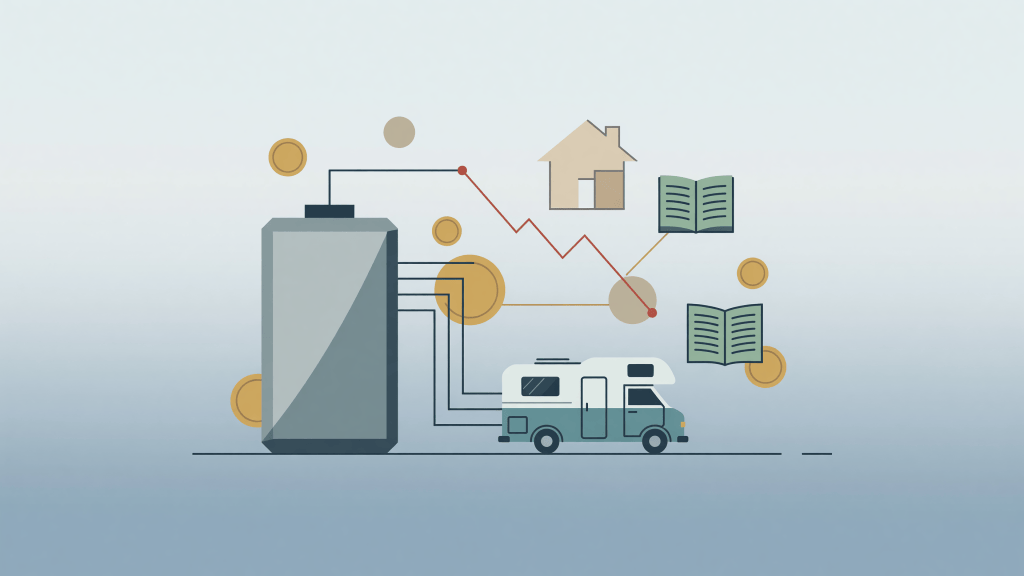
Can you charge lithium batteries below freezing? The short answer is no — and if your battery management system doesn’t stop it automatically, you can cause permanent, irreversible damage in a single cold night. This is one of the most misunderstood rules in van life electrical, and it catches builders off guard right when they need their power bank most: parked in the mountains in January with the solar panels dusted in snow and the alternator itching to top things up.
This post explains exactly what happens inside a LiFePO4 cell when you charge it in freezing temperatures, what your BMS low temperature cutoff is actually doing, and how experienced van lifers keep their battery banks healthy through a full winter season.
Why Cold Charging Destroys a Lithium Cell
LiFePO4 batteries — the chemistry almost every serious van build uses for a house bank — work by moving lithium ions between electrodes during charge and discharge. At temperatures below freezing, the electrolyte becomes sluggish and the ions can no longer move cleanly to their intended positions.
Instead of intercalating neatly into the anode, lithium plates onto the surface as metallic lithium — a process called lithium plating. Those metallic deposits don’t dissolve back on the next discharge cycle. They accumulate, reduce capacity permanently, and in serious cases form dendrites: tiny conductive spikes that can bridge the cell internally and cause a short. That’s not a recoverable situation.
The damage is invisible on the outside. Your battery may read full voltage and appear healthy while its real capacity has quietly shrunk. You won’t notice until a winter boondocking trip reveals that your bank dies hours earlier than it should.
What a BMS Low Temperature Cutoff Actually Does
A quality lithium battery — especially anything sold for van life or off-grid use — includes a battery management system with a low temperature cutoff for charging. When the cell temperature drops to the manufacturer’s threshold (commonly around 32°F / 0°C, though this varies by cell and brand), the BMS opens the charge circuit entirely. Solar charge controllers, DC-DC chargers, and shore power chargers all get blocked at the battery terminals.
This is the BMS doing exactly what it’s supposed to do. The problem is that many builders treat a BMS cutoff event as a malfunction. They see zero amps going into the battery on a sunny morning and assume something is broken, when in reality the protection system is working correctly.
Not every battery on the market has reliable low-temperature charge protection. Budget cells and older AGM-replacement drop-ins sometimes carry the label without the circuitry to back it up. If you’re speccing out a build or replacing a bank, it’s worth verifying the BMS temperature cutoff spec in the actual datasheet — not just the marketing page.
For a deeper look at how your BMS fits into the full electrical system, our Van Life Electrical for Beginners guide walks through every protection layer from fusing to battery management in plain language.
Real Van Life Cold Weather Charging Problems (And Their Fixes)
Here’s where winter van life electrical gets genuinely tricky. Your battery is cold, the BMS has locked out charging, but you’ve got solar hitting the panels and an alternator spinning every time you drive. None of that energy can get in. The fix isn’t to override the protection — it’s to warm the battery first.
The strategies experienced builders use fall into a few categories:
| Strategy | How It Works | Typical Use Case |
|---|---|---|
| Self-heating battery | Internal heating pads warm cells using a small draw from the pack itself before accepting charge | Sub-freezing overnight parking; no external heat source |
| Insulated battery box | Foam or rigid insulation slows heat loss; body heat from the living space keeps cells above threshold | Mild cold (near-freezing nights); battery inside the van |
| Small heating pad (thermostatically controlled) | Low-wattage pad attached to battery exterior, triggered by a temperature probe | Batteries mounted in an exterior compartment or cargo area |
| Delay charging until midday | Let the sun warm the vehicle interior and the battery naturally before engaging solar or DC-DC | Mild winter climates; batteries inside insulated build |
The self-heating battery option has become significantly more accessible as LiFePO4 prices have come down. If you’re building in a climate that sees hard winters regularly, it’s worth pricing into the build from the start rather than retrofitting later.
One thing many builders overlook: even if your battery is warm enough to accept charge, winter solar output is a fraction of what panels deliver in summer. An array that handles your power budget comfortably in July may barely keep up with standby loads in December at northern latitudes. The alternator — via a proper DC-DC charger — becomes your most reliable charge source in winter. Two hours of highway driving can deliver more usable amp-hours than a short, low-angle winter day of solar. For a full breakdown of why winter solar underperforms so dramatically, this post on winter solar problems covers the honest numbers.
How to Keep Your LiFePO4 Healthy Through a Full Winter
Battery longevity in laboratory testing for LiFePO4 chemistry runs into the thousands of cycles at high depth of discharge — but real-world vehicle service life runs materially shorter, and cold-charging damage accelerates degradation faster than almost any other factor.
A few practical habits make the biggest difference across a winter season:
| Habit | Why It Matters |
|---|---|
| Never force a charge when the BMS has cut out | The cutoff exists for a reason; bypassing it causes the plating damage described above |
| Keep the battery inside the insulated living space | Ambient heat from your body and any heating source keeps cells above threshold overnight |
| Monitor cell temperature, not just state of charge | A battery at 20% charge but warm is safer to charge than one at 50% that’s been sitting at 28°F |
| Lean on your DC-DC charger in winter | Driving is predictable; solar in winter is not — build your winter power plan around drive time |
| Check BMS logs or indicator lights after cold nights | Confirms the cutoff triggered correctly and gives you confidence the protection is working |
If your build is still in the planning stage, positioning the battery bank inside the van — rather than in an exterior storage bay — is one of the highest-value decisions you can make for cold-climate van life. Thermal mass from the living space does an enormous amount of work for free.
The National Park Service and Recreation.gov are both worth bookmarking for planning winter boondocking locations — knowing whether you’ll have access to sun angles and driving routes on a given trip helps you plan the charging strategy before you’re already parked in the cold.
If you want every piece of this — battery chemistry, BMS protection layers, DC-DC sizing, winter power planning — in one place rather than scattered across forum threads, Van Life Electrical for Beginners from The Skill Mill is written specifically for builders who want to understand their system, not just copy someone else’s parts list. It covers the full build from fusing to solar to alternator charging in plain, honest language.
Frequently Asked Questions
At what temperature does a LiFePO4 battery stop accepting a charge?
Most LiFePO4 batteries have a BMS low temperature cutoff set around 32°F (0°C), though the exact threshold varies by manufacturer and cell. Always check the datasheet for your specific battery rather than assuming a standard value.
Will my solar charge controller know to stop charging when the battery is too cold?
Most solar charge controllers do not have battery temperature sensing on their own. It is the BMS inside the battery that blocks the charge — the controller may still try to push current, but the BMS refuses it at the terminals. Some advanced MPPT controllers support a battery temperature sensor accessory that adjusts behavior, but the primary protection in a modern LiFePO4 system lives in the BMS.
Does the cold temperature limit apply to discharging as well?
Discharging a LiFePO4 battery in cold temperatures is generally permissible at lower temperatures than charging, though capacity drops noticeably as temperatures fall. The hard prohibition — and the one that causes permanent damage — is specifically on charging below the threshold. Always check your battery’s discharge temperature specification as well, since very deep cold affects that too.
Can I use a heating pad to warm my battery before charging in the morning?
Yes — a thermostatically controlled heating pad is a practical solution, especially for batteries mounted in exterior compartments. The key word is thermostatically controlled: a pad that runs continuously wastes power and can overheat cells. Set the thermostat to bring cells just above the charge cutoff threshold, not to maintain a high temperature.
{“@context”:”https://schema.org”,”@type”:”BlogPosting”,”headline”:”Can You Charge Lithium Batteries Below Freezing? The Rule That Ruins Batteries”,”description”:”Can you charge lithium batteries below freezing? Learn the exact temperature limit, what your BMS does about it, and how to protect your van build all winter long.”,”keywords”:[“charging lithium batteries in cold weather van life”,”lithium battery temperature limits winter camping”,”can you charge LiFePO4 below 32 degrees”,”van life battery bank cold weather protection”,”lithium battery BMS low temperature cutoff”,”winter van life solar charging problems”,”how to keep lithium batteries warm in van”,”cold weather battery charging damage prevention”,”van life electrical system freezing temperatures”,”LiFePO4 battery cold charge protection van build”],”datePublished”:”2026-08-31T17:34:41.643Z”,”dateModified”:”2026-08-31T17:34:41.643Z”,”author”:{“@type”:”Organization”,”name”:”The Skill Mill”},”mainEntityOfPage”:”https://blog.theskillmillbooks.com/can-you-charge-a-lithium-battery-below-freezing-the-rule-tha/?utm_source=skillmillblog&utm_medium=blog&utm_campaign=van-life-electrical&utm_content=can-you-charge-a-lithium-battery-below-freezing-the-rule-tha”}
Tools that help: kdp_vanlife · our Vault & Press spreadsheet · MineStock Pro.


Leave a Reply